
The South China Sea dispute has become one of the most pressing geopolitical challenges of the 21st century. At first glance, it might seem like a distant maritime quarrel, but beneath its waters lies a web of strategic, economic, and political stakes that could reshape global power dynamics.
From competing territorial claims to resource competition and military posturing, the South China Sea conflict has evolved into a test of international law — and of how far major powers are willing to go to defend their interests.
Why Is the South China Sea So Important?
Stretching across a vital corridor in the Indo-Pacific, the South China Sea (SCS) is more than just a body of water it’s the beating heart of global trade. Nearly 24% of the world’s maritime commerce, worth about $5.3 trillion, passes through it each year. The sea is also rich in oil, gas, and fisheries, making it a vital lifeline for surrounding nations.
Six countries China, Vietnam, the Philippines, Malaysia, Brunei, and Indonesia claim parts of the South China Sea. The overlapping exclusive economic zones (EEZs) have created one of the most complex maritime disputes in modern history.
China’s Nine-Dash Line: A Source of Endless Tension
At the center of the China South China Sea claims lies the controversial nine-dash line a U-shaped boundary that appears on Chinese maps, enclosing almost the entire sea.
Beijing argues its claim is rooted in historical usage, citing old maritime charts, while neighboring nations rely on UNCLOS (United Nations Convention on the Law of the Sea), which limits territorial waters to 200 nautical miles from the coast.
China’s refusal to clarify the exact legal meaning of the nine-dash line has left other countries uncertain and uneasy. The ambiguity itself works in Beijing’s favor, allowing it to assert control while keeping rivals off balance.
The Legal Battle: Philippines vs. China
The turning point came in 2013, when the Philippines filed a case against China with the Permanent Court of Arbitration (PCA) under UNCLOS. After three years of review, the 2016 ruling was decisive:
-
China’s nine-dash line had no legal basis.
-
None of the Spratly Islands qualified as “islands” with their own EEZs.
-
China’s actions had violated the Philippines’ sovereign rights.
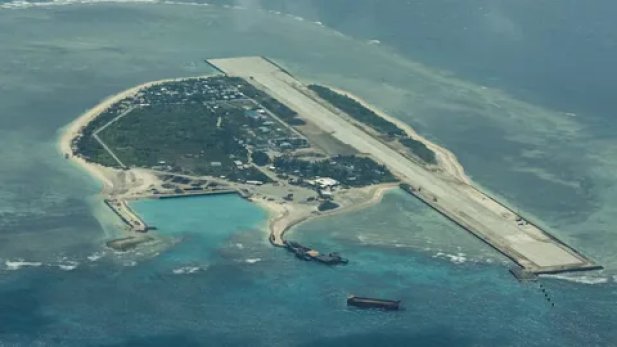
The decision should have been a victory for international law but China simply rejected the ruling and continued its expansion, building artificial islands equipped with airstrips, radar systems, and military outposts.
Economic and Environmental Fallout
The South China Sea conflict has far-reaching economic implications. The disputed waters are believed to contain up to 11 billion barrels of oil and 190 trillion cubic feet of natural gas, not to mention one of the world’s richest fishing grounds.
Because of the ongoing tensions, many coastal nations cannot safely explore or extract these resources, leading to missed development opportunities and economic uncertainty.
Local fishermen are often caught in the middle, facing harassment and blockades from Chinese coast guard vessels. These incidents not only threaten livelihoods but also increase the risk of armed confrontation.
The Political Ripple Effect
Beyond economics, the South China Sea dispute has become a stage for great power rivalry. As China strengthens its military presence, countries like the Philippines and Vietnam have drawn closer to the United States for defense cooperation.
This alignment has deepened the divide between Beijing and Washington two powers already locked in strategic competition across the Indo-Pacific.
For China, maintaining dominance in the South China Sea is tied to both national pride and regime legitimacy. For the United States, ensuring freedom of navigation is essential to protecting global trade and countering Chinese influence. The result is an increasingly militarized sea, where even a small skirmish could trigger broader consequences.
Is There a Way Forward?
While diplomacy remains the preferred path, it’s also the most fragile. ASEAN has repeatedly called for peaceful dialogue and a code of conduct, but progress is slow, and mistrust runs deep. China continues to expand its control while offering limited negotiations on its own terms.
To prevent the South China Sea conflict from escalating, regional players must focus on clear communication, legal adherence, and joint resource management. Without this, the region risks sliding further into instability one incident away from crisis.
Conclusion: The Stakes Are Global
The South China Sea dispute is no longer a regional issue. Its outcome will shape the future of international law, trade routes, and power balance in Asia and beyond. Whether this contested sea becomes a zone of cooperation or conflict will depend on the willingness of nations both within and outside the region to prioritize diplomacy over domination.