
From the perspective of an insurance risk assessor, introducing an open flame into a residential environment immediately raises a massive red flag. While a fire pit is a highly desirable lifestyle feature, it is also a leading cause of preventable property damage and severe liability claims. A spark landing on a dry roof, intense heat shattering an adjacent glass door, or a guest tripping into an unguarded flame can result in devastating financial and legal consequences. When homeowners consider Fire Pit Installations in Iowa, they must prioritise absolute safety and rigorous code compliance over mere aesthetics. Professionally engineered, permitted installations are the only way to mitigate these severe risks, protect your property, and ensure your homeowner's insurance policy remains valid in the event of an accident.
The Danger of Unpermitted DIY Installations
The most significant risk to a homeowner is an unpermitted, DIY fire feature. If a homeowner builds a brick fire ring without pulling the necessary municipal permits and having the structure professionally inspected, they are operating entirely outside the law. If that illegal fire pit subsequently causes a fire that damages their home or spreads to a neighbour's property, the insurance company will almost certainly launch a thorough investigation. Upon discovering the unpermitted, non-compliant structure was the source of the blaze, the insurer has strong legal grounds to deny the claim entirely, leaving the homeowner personally liable for hundreds of thousands of dollars in damages. Professional, permitted installation is a non-negotiable insurance requirement.
Wood vs. Gas: Assessing the Risk Profile
Insurance underwriters view wood-burning and gas fire features very differently. Wood-burning pits represent a significantly higher risk profile. They produce unpredictable, flying embers that can easily ignite nearby dry vegetation, timber decking, or overhanging roof eaves. Furthermore, the intense, uncontrolled heat can crack standard masonry. Gas fire features, however, are viewed far more favourably. A professionally installed, CSA-certified gas burner produces zero sparks or embers and offers immediate, absolute control over the flame height and heat output. Because the risk of accidental ignition is drastically lower, many insurance companies prefer, and sometimes mandate, the use of approved gas appliances over traditional wood-burning pits in dense suburban environments.
Enforcing Strict Non-Combustible Clearances
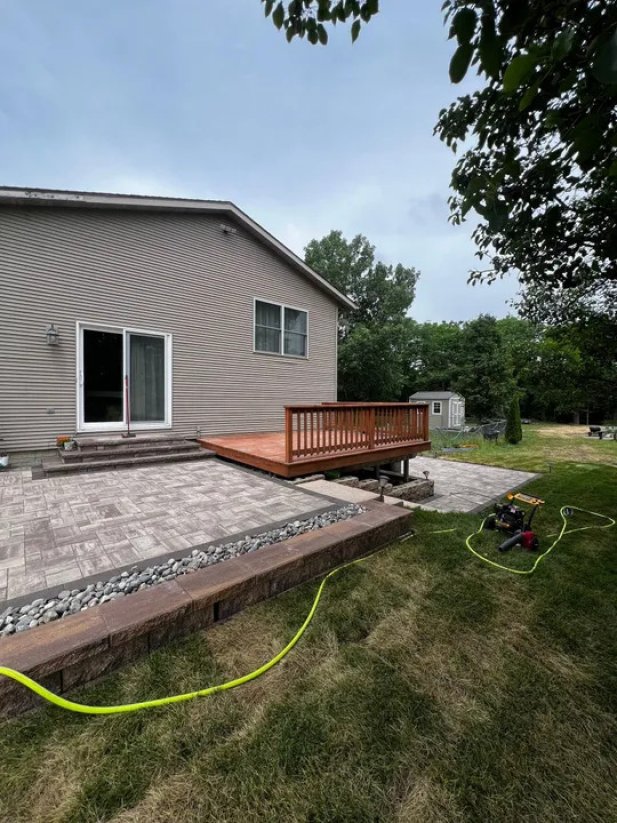
A significant portion of fire-related claims stem from radiant heat damage rather than direct flame contact. If a fire pit is placed too close to a house, the intense radiant heat can easily melt vinyl siding, shatter tempered glass windows, or warp composite decking. We mandate strict adherence to non-combustible clearances. The fire feature must be situated a safe, code-compliant distance from all structures and property lines. Crucially, the base upon which it sits must be entirely fireproof. Placing a fire pit directly on a wooden deck is a severe hazard; it must be installed on a deep, expansive pad of poured concrete, natural stone, or thick paving bricks, ensuring the intense downward heat cannot ignite the surface below.
Integrating Emergency Shut-Off Mechanisms
For gas fire installations, safety engineering goes beyond the burner itself; it must include failsafe mechanisms. A professional installation requires the integration of an easily accessible, clearly marked emergency gas shut-off valve, located a safe distance away from the fire feature itself. In the event of a malfunction, a sudden change in wind, or an emergency situation, the homeowner must be able to instantly and safely cut the fuel supply without having to reach into or near the flames. Furthermore, high-end systems often include automated thermocouple sensors that instantly shut off the gas flow if the flame is accidentally blown out, preventing the dangerous, invisible buildup of explosive gas.
Conclusion
A fire pit should be a source of relaxation, not a source of constant anxiety and financial liability. By insisting on professional, permitted construction, strongly considering the safety advantages of gas systems, enforcing strict non-combustible clearances, and integrating essential emergency shut-offs, you drastically mitigate the inherent risks of open flames. A rigorously compliant installation protects your property, your guests, and the validity of your homeowner's insurance policy.
Call to Action
Do not compromise your home's safety or your insurance coverage with an amateur fire pit. Contact our certified installation experts today to design and build a perfectly compliant, risk-free fire feature.