
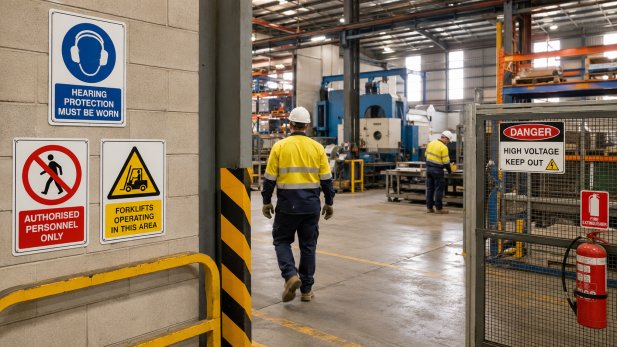

Let’s be honest: safety in Australian workplaces can easily slip onto the back burner. We purchase a few signs, stick them on the wall, and cross our fingers. But if an auditor were to come by your place tomorrow through the main entrance, do you really think your arrangements would look good to her or would you incur a huge fine? It’s easy to think "she'll be right," but ignoring visual hazards is a massive gamble. Safe Work Australia data highlights a sobering reality: about forty per cent of workplace fatalities involve people who simply weren't clearly visible on site. Complying with AS 1319-1994 is not a bureaucratic box-ticking exercise. Getting your workplace safety signs up to scratch is a genuine lifesaver, keeping your team safe and protecting your business from devastating legal liability.
Compliance Matters: AS 1319-1994 and the Law
Standards Australia prepared the AS 1319-1994 framework to give our various local industries a single, universal visual language. While technically voluntary on its own, complying with this framework is the accepted benchmark for meeting your "general duty of care" obligations under the WHS Act 2011.
A WorkSafe inspector will check your signs as a direct reflection of your safety culture. Dropping the ball here isn't just a slap on the wrist. It can lead to:
- Individual fines of up to fifty thousand dollars.
- Corporate penalties exceeding half a million dollars.
- Immediate shutdown notices.
The Standard Categories: Blue, Red, and Yellow
Understanding this visual system is key to choosing the right tools. When setting up a workspace, many managers struggle to grasp the functional difference between mandatory warning and prohibition signs on site. It helps to look at their designs and what they tell workers to do:
- Mandatory Signs: These feature a solid blue circle with a white pictogram. They dictate what must be done, like wearing safety boots or hearing protection.
- Prohibition Signs: These use a red circle with a diagonal slash running over a black icon to show what is strictly banned, like "No Entry" rules.
- Warning Signs: These warn of medium-risk hazards requiring general caution, using a yellow triangle with black borders.
Sizing and Placement: Making Sure Signs Can Be Read
Getting the correct symbol is only the first part. If the sign is too tiny, you won't even notice it. Per AS 1319, the sizes have to do with the viewing distance. It's quite easy math: uppercase letters on the signs have to be at least 5mm for every viewer meter, while pictograms have at least 15mm of height for every viewer meter.
If your floor is dirty or dark, then standard sizes will be inadequate. Increase the size by half to be on the safe side. Besides that, hanging signs at eye level (1.5 to 1.7 metres off the ground) at zone entry points would be a good move for enabling workers to put on the gear before they enter the area.
Material Choice: Surviving the Australian Elements
Don't buy cheap. Our harsh sun is brutal on materials, with summer UV routinely hitting extreme levels. A cheap indoor sticker will crack in months if left outside.
Match the material of the signage to the environment if you want it to last:
- Permanent outdoor spaces need materials that won't corrode.
- Photoluminescent materials that glow in the dark work great in situations where there's very little or no light, such as dark warehouse corners or emergency exit routes.
This one has to be so obvious that a baby would get it. It saves you money on constant replacements and keeps your site looking professional.
Defeating "Sign Blindness" with Regular Audits
Even with a perfectly designed layout, you still have to deal with "sign blindness." Over time, people habituate to their surroundings. Employees with five or more years on site are actually thirty-three per cent more likely to overlook hazards because they’ve become blind to the static signs they pass every single day.
To make sure you are all set with a new batch, you just have to check your site on a regular basis, for example, every six months. Remove the placards that got damaged, and update the warnings for the potential hazards.
To get the top-of-the-range safety signs in Melbourne, we highly recommend you collaborate with a reliable local manufacturer who not only will guarantee the quality, but who also will fully understand and comply with the WorkSafe regulations in Victoria. A local team will be right on the money when it comes to customising site-specific warnings, selecting materials that can survive Port Phillip’s damp winters, and arranging clean, easy-to-read sign clusters at your entry points.
Conclusion:
In the end, workplace safety signs are not just a small task; they are an actual risk management device. When signs have lost their vividness, contain wrong information, or have been fully covered/hidden, they are practically the same as having no sign. Ensuring that your entire physical site is made of standardised material, together with checking for compliance from time to time, not only gives a safe environment for work staff but also lessens risks and eventually builds an environment where safety comes first.






























You ought to get involved in a contest personally of the finest blogs on-line. I will recommend this page! 소액결제 현금화