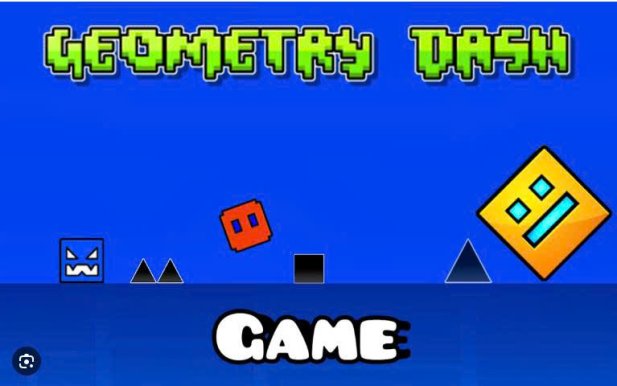

No complex combos, no inventory menus, no skill trees to agonize over — just you, a pulsing cube, and a beat that refuses to slow down. Geometry jump games have carved out a quiet but devoted corner of the gaming world by nailing exactly that formula. They are quick to pick up, hard to master, and impossible to forget once you start tapping.
At the heart of the genre sits Geometry Dash, the rhythm-driven reflex gauntlet that turned one-touch gameplay into an art form. Whether you are returning after a long break or just discovering the genre fresh, this article will walk you through what the experience is actually like, how the core gameplay holds together, and a few practical tips to help you survive longer than your first five seconds.
Introduction: One Tap, Endless Chaos
The beauty of a geometry jump game lies in its simplicity. You control a small shape — usually a glowing cube — and your only job is to make it leap. The terrain scrolls toward you automatically, littered with spikes, ledges, gaps, and traps of increasing cruelty. Tap to jump. Hold to fly. That is it.
But the genius emerges when the obstacles are synced to music. Each jump feels less like a mechanical input and more like a note in a song you are learning to play. Mistime a leap and the cube shatters instantly, resetting you to the beginning — there are no checkpoints in the classic mode. That loop of jump, crash, restart, jump a little further feels almost meditative once you settle into it. You are not just playing a level; you are memorising a rhythm.
This is the core appeal of geometry jump games. They sit somewhere between an action platformer, a rhythm title, and a memory puzzle. The difficulty is fair because it is consistent — the same inputs in the same order will always produce the same result. When you finally complete a level that took you two hundred attempts, the satisfaction is immense and entirely earned.
Gameplay: How the Jump Actually Works
In Geometry Dash, your cube moves forward on its own. Tapping the screen (or clicking, or pressing spacebar depending on your platform) makes the cube jump. The jump arc is fixed — the same height every time — which means success is about timing rather than power. You cannot jump harder or softer; you can only jump at the right moment.
As levels progress, the game introduces new modes that change how your shape behaves. In ship mode, holding the input makes your craft ascend and releasing it makes it descend, requiring gentle, balanced taps to thread through narrow corridors. The ball mode flips gravity on each tap, demanding that you rewire your brain mid-level. Cube, ship, ball, UFO, wave, robot — each mode has its own feel, and part of the challenge is smoothly transitioning between them without pausing to recalibrate.
The obstacles themselves are straightforward visually but brutal in combination. Spikes kill on contact. Blocks can be landed on or are sometimes fake, dropping you into a pit. Pulsing rings and coloured pads modify your jump — yellow pads give a small boost, pink pads launch you much higher. Portals switch your mode instantly. Yellow and blue gravity portals flip you upside down. Speed portals make the whole world sprint faster.
All of this is layered over a soundtrack that is not just background decoration. The level design is choreographed to the music, which means listening carefully is a genuine strategy. A sudden drop in the track often signals a mode change. A build-up of tension usually precedes a burst of speed. Players who treat the audio as a guide rather than decoration consistently perform better than those who mute it.
Tips: Survive Longer and Enjoy the Ride
Start by treating practice mode as your real classroom. Most geometry jump games include a mode where you can place checkpoints freely, letting you learn a tricky section before attempting it for real. Do not skip this. Repeated exposure builds muscle memory, and muscle memory is the entire point.
Respect the music. If a section keeps killing you, try closing your eyes for a moment and listening to the beat that accompanies it. Often the jump timing maps directly onto a drum hit or a synth stab. Tapping in time with what you hear will get you further than staring at the screen in panic.
Use breaks wisely. Geometry jump games are infamous for the wall of frustration that appears around attempt fifty or so, when you know a section but your fingers will not cooperate. Step away for ten minutes. Come back, and your hands will often do what your mind already knew.
Play with your hands, not your eyes. Veteran players often describe the experience as feeling the level rather than watching it. Your eyes will always lag slightly behind your reflexes; trust the beat and let your timing carry you through sections your brain has not fully processed yet.
Finally, remember that progress is measured in small victories. Surviving one more jump, reaching one new portal, shaving seconds off a failure — these are the milestones. Celebrate them, because they are how mastery is actually built in this genre.
Conclusion: Patience Rewarded
The geometry jump genre is a reminder that games do not need sprawling maps or cinematic cutscenes to be gripping. A single cube, a single button, and a relentless beat are enough to create something genuinely absorbing. The learning curve is steep, the restarts are frequent, and the spikes are merciless — but every completed level feels like a small triumph that nobody handed you.
If you have never tried one, pick a level, turn the volume up, and let yourself fail a few dozen times. The rhythm will click eventually, your fingers will find their timing, and somewhere around attempt eighty you will clear a jump you thought was impossible. That quiet moment of victory is what geometry jump games are really about, and it is well worth the bruises to get there.