
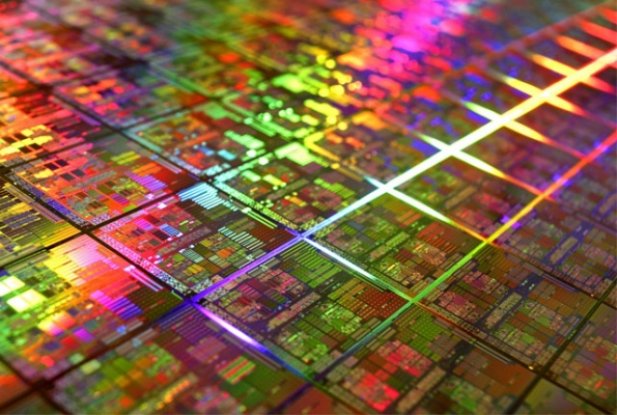

Both Intel’s Kaby Lake and AMD’s Ryzen chips are manufactured on a 14nm process node, which refers to the size of the chip’s transistors. The smaller the manufacturing process, the more transistors can fit on a single die. Microprocessors are one of the most complex products in the world, and creating these chips is a difficult and precise process. The steps we have outlined below are the most basic stages in the fabrication process, and many steps are repeated, altered, or omitted – depending on chip design.
Below is an overview of how an Intel desktop processor is made.
Start with sand
The process of creating a computer chip begins with a type of sand called silica sand, which is comprised of silicon dioxide.
Silicon is the base material for semiconductor manufacturing and must be pure before it can be used in the manufacturing process.
Silicon ingot
Multiple purification and filtering processes are performed in order to deliver electronic-grade silicon, which has a purity of 99.9999%.
A purified silicon ingot, which weighs around 100kg, is shaped from melted silica and made ready for the next step.
Cut wafers
The circular silicon ingot is sliced into wafers as thin as possible while maintaining the material’s ability to be used in the fabrication process. The silicon wafers are then refined and polished in order to provide the best possible surface for the following fabrication steps.
Photolithography
After being polished and readied for the process, a layer of photoresist is spread thinly across the wafer. This layer is then exposed to a UV light mask, which is shaped in the pattern of the microprocessor’s circuits. Exposed photoresist becomes soluble and is washed off by a solvent.
Ions and Doping
Exposed photoresist is washed off and the silicon wafer is bombarded with ions in order to alter its conductive properties – this is called doping. The remaining photoresist is then washed off, revealing a pattern of affected and unaffected material.
Etching
A pattern of hard material is applied to the wafer using another photolithography step. Chemicals are then used to remove unwanted silicon, leaving behind thin silicon ridges. After this, more photolithography steps are applied – which create more of the transistor structure, depending on which gate formation is being used.
Electroplating
An insulation layer is applied to the surface of the almost-complete transistor and three holes are etched into it. Next, manufacturers use a process called electroplating to deposit copper ions on the surface of the transistor, forming a layer of copper on top of the insulation. The excess copper is polished off, leaving only three copper deposits in the insulation layer holes.
Layering Interconnects
All the transistors are now connected in an architecture which allows the chip to function like a processor. The layering and design of these interconnects is incredibly complex, and there can be over 30 layers of metal connections in a single processor.
Test and Slice Die
The chips on the wafer are now ready to be tested. The wafer is sliced into dies, and functional dies move on to the final step in the fabrication process.
Packaging
Dies are packaged with a substrate and heat spreader, and assume the familiar form factor of a desktop processor. The heat spreader conducts heat away from the silicon and into the heatsink mounted on top of it. Processors are then tested for power efficiency, maximum frequency, and other performance metrics.
Those that pass are then packaged as a retail product.



Absolutely amazing this. Here is a picture of Intels first CPU processor, the 4004! It was first advertised for sale on November 15, 1971!