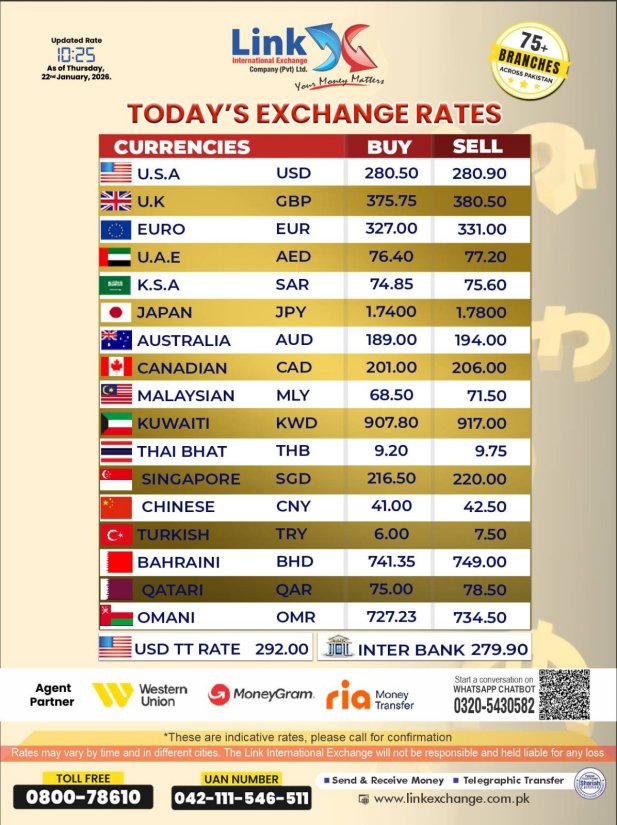

The USD to PKR exchange rate stands at approximately 279.76 PKR per USD as of January 21, 2026, reflecting a slight downtrend of -0.17% year-to-date. Investors in Pakistan, including those in currency exchanges like Link Exchange, monitor this pair closely due to its impact on remittances, imports, and portfolio returns. This analysis breaks down trends, drivers, and strategies for navigating volatility.
Current Rate Overview
Pakistan's liquid foreign reserves reached $21.19 billion by early January 2026, up $141 million week-on-week, bolstering PKR stability. The rate hit a January high of 281.69 PKR on January 8 but dipped to 279.64 on January 20, averaging 280.06 PKR so far. Remittances hit $19.7 billion in H1 FY26, up 11% year-over-year, providing key USD inflows that temper depreciation pressures.
In December 2025, CPI inflation eased to 5.6% year-on-year, within the State Bank of Pakistan's 5-7% target, supporting a controlled PKR environment. SBP holds $16.06 billion in reserves, with banks adding $5.14 billion, yielding 2.65 months of import cover. For investors, this signals short-term PKR resilience amid global USD fluctuations.
Historical Trends
From 2020 to 2026, USD/PKR surged from around 160 to over 280, driven by Pakistan's economic challenges like floods and debt. Key milestones include a 2022 peak near 230 amid IMF negotiations and 2023-2024 climbs past 278 on reserve drains. In 2025, rates stabilized around 278-282 as remittances rebounded post-floods.
January 2026 data shows daily fluctuations: January 1 at 280.23, peaking at 281.69 on January 8, then sliding to 279.64 by January 20. This -0.15% monthly dip mirrors broader USD weakness projections. Investors note patterns: PKR strengthens on remittance spikes (e.g., December 2025's $3.6B, +17% YoY) but weakens on oil shocks or US rate hikes.
|
Date (Jan 2026) |
USD to PKR Rate |
|
Jan 1 |
280.23 |
|
Jan 8 (High) |
281.69 |
|
Jan 20 (Low) |
279.64 |
|
Average |
280.06 |
Key Influencing Factors
Inflation differentials pressure PKR: Pakistan's 5.6% rate lags US levels, eroding purchasing power and inviting depreciation. Balance of payments deficits, eased by $3.2B in September 2025 remittances (+11.3% YoY), remain vulnerable to GCC labor shifts. Foreign reserves at $21B offer a buffer but trail pre-2022 peaks.
The US Fed funds rate at 3.5-3.75% eyes two 2026 cuts, potentially weakening USD via lower yields. Pakistan's projected 3.5% GDP growth in 2026 supports recovery but faces oil price risks from geopolitical tensions. Public debt and speculation amplify swings: political stability or IMF inflows can rally PKR 2-5% short-term.
Remittances from the US ($267M+ monthly) and EU provide a steady USD supply, countering trade deficits. The global USD index may dip to 94 in Q2 2026 before rebounding on US growth.
Investment Strategies
Carry trades thrive on PKR's high rates (SBP policy ~11.5% post-cuts) versus US 3.5%, yielding 8%+ spreads minus volatility. Hedge with forwards via SBP-regulated exchanges like Link Exchange for remittances or trades. Time entries on dips below 279 PKR, targeting 282+ on US data releases.
Diversify: Allocate 20-30% to USD assets for Pakistani investors facing import needs in autos/pharma. Monitor SBP interventions; reserves above $20B signal PKR support. Use momentum trading on news: +17% remittance jumps lift PKR 1-2%. Risks include devaluations (e.g., 2023-style 5% drops) and controls.
|
Strategy |
Opportunity |
Risk |
|
Carry Trade |
High PKR yields |
Volatility spikes |
|
Remittance Hedging |
Predictable inflows |
GCC slowdowns |
|
Speculation |
News-driven swings |
Political shocks |
Future Forecast
USD/PKR may range from 272 to 280 through mid-2026, with growth to 280.65 by February on a USD rebound. Pakistan's 3.5% GDP and moderating inflation (5-6.5%) cap depreciation at 2-3% annually. Upside risks: Fed pauses cuts amid US stimulus; downside from oil surges or reserve dips.
Longer-term (2027-2030), reforms could stabilize at 285-300 if remittances hit $35B yearly. Investors should track SBP policy (next cut possible in Q1) and US payrolls for cues. For Pakistan-based traders, blending local insights with global data maximizes edge.