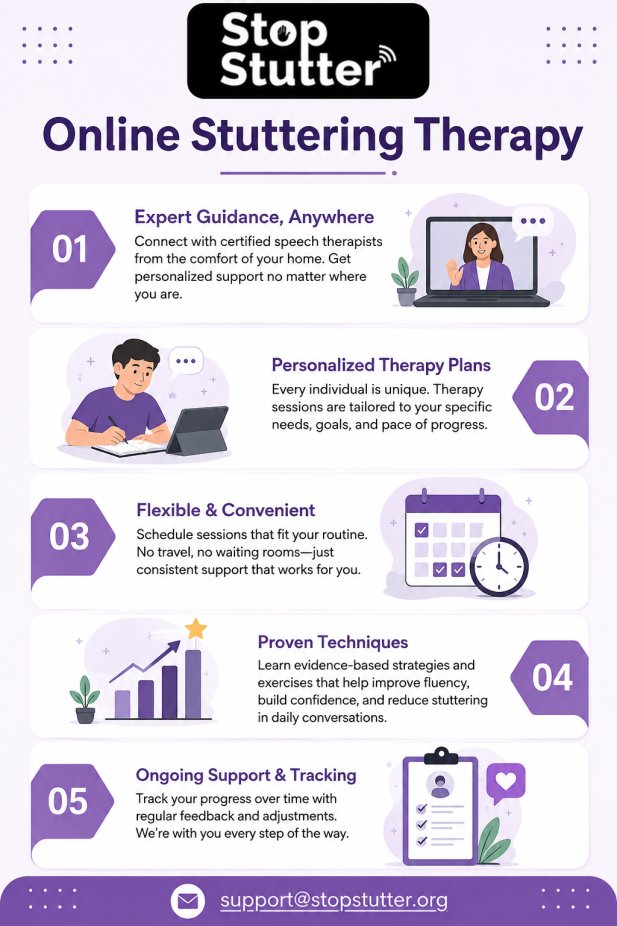

The way people access speech therapy has changed dramatically in recent years. What was once limited to in-person clinical visits now extends to video calls, app-based practice, and virtual coaching sessions you can do from your living room. For people who stutter, this shift raises an important question: does online speech therapy work as well as sitting across from a therapist in their office? The answer is more encouraging than many expect, but there are important factors to consider before choosing one format over the other.
How Online Speech Therapy Works
Online speech therapy, also called teletherapy, uses video conferencing platforms to connect you with a speech-language pathologist or stuttering coach in real time. Sessions look and feel similar to in-person appointments. Your therapist can observe your facial movements, breathing patterns, and physical tension. They can model techniques, provide immediate feedback, and guide you through speaking exercises. Most platforms also allow screen sharing, which is useful for reviewing reading passages, visual cues, and progress-tracking tools.
The key difference is convenience. You do not need to commute, sit in a waiting room, or rearrange your schedule around clinic hours. You log in from wherever you are, complete your session, and go back to your day. For adults who work full-time, live in rural areas, or feel self-conscious about walking into a speech therapy clinic, that convenience is not just a nice perk. It is often the difference between getting help and putting it off indefinitely.
What the Research Says
Multiple studies have compared outcomes between online and in-person speech therapy for stuttering, and the findings are consistent: teletherapy produces results that are statistically comparable to traditional face-to-face treatment. A study published in the Journal of Telemedicine and Telecare found no significant difference in fluency outcomes between the two formats for adults who stutter. Participants in both groups showed similar improvements in stuttering frequency, speaking confidence, and overall communication satisfaction.
Another research review examining telehealth applications across speech-language pathology concluded that client satisfaction with online therapy was equal to or higher than in-person sessions. The convenience factor played a significant role in adherence. People who could attend sessions without the logistical burden of traveling to a clinic were more likely to show up consistently, and consistency is one of the strongest predictors of therapy success.
Advantages of Online Therapy
Beyond convenience, online therapy offers several specific benefits for people who stutter. First, it expands your access to specialists. Stuttering therapists with deep expertise are not evenly distributed geographically. You might live in a city with dozens of SLPs but none who specialize in fluency disorders. Online therapy removes that barrier entirely. You can work with the best stuttering specialist available regardless of where either of you lives.
Second, practicing speech techniques in your own environment can accelerate the transfer of skills to daily life. One of the biggest challenges in stuttering therapy is using techniques learned in a clinical setting in real-world situations. When your therapy happens in the same space where you make phone calls, attend virtual meetings, and have conversations with family, the gap between practice and real life shrinks.
Third, teletherapy tends to reduce the self-consciousness that some clients feel in a waiting room or clinic setting. For adults who have spent years hiding their stutter, the privacy of logging in from home can make it easier to be open and honest about their struggles.
Advantages of In-Person Therapy
In-person therapy has its own strengths that online sessions cannot fully replicate. Physical presence allows a therapist to observe body language, posture, and breathing mechanics more holistically. Some techniques, like diaphragmatic breathing exercises and physical tension-release methods, are easier to teach and correct when the therapist can see your entire body rather than just your face and shoulders on a screen.
In-person sessions also create a stronger sense of structured routine for some people. Leaving your house, driving to a clinic, and sitting in a therapy room creates a mental separation between your daily life and your therapy work. That boundary can help you focus and take the process seriously in a way that is harder to achieve when therapy happens on the same laptop you use for scrolling social media.
Group therapy and intensive programs also tend to work better in person. The energy of a shared physical space, the ability to practice with multiple speaking partners, and the camaraderie that develops between participants in a weekend intensive are difficult to replicate over video. Many stuttering programs offer immersive multi-day workshops that rely heavily on in-person interaction for their impact.
Which Format Is Better for You?
The honest answer is that neither format is universally better. The best choice depends on your circumstances, preferences, and goals. If you value convenience, need access to a specialist who does not practice in your area, or prefer the comfort of practicing in your own space, online therapy is an excellent option with strong evidence behind it. If you learn better with physical presence, want access to group settings, or benefit from the routine of attending a clinic, in-person therapy may serve you better.
Many people find that a hybrid approach works best. They start with in-person sessions to build foundational skills and establish rapport with their therapist, then transition to online sessions for ongoing maintenance and real-world practice. Others begin online and supplement with occasional in-person intensives to accelerate their progress.
Self-help programs and coaching communities also fit into this picture. The World Stop Stuttering Association offers a methodology that works entirely through virtual coaching and community support, making it accessible to anyone with an internet connection. For people who want to take control of their own recovery outside the traditional therapy model, this kind of structured self-help can be a powerful option.
Making a Practical Decision
Whatever format you choose, the most important factor is getting started. Every month spent hesitating is a month of missed progress. As you evaluate your options, one practical step is understanding what the financial commitment looks like across different formats. Online therapy, in-person sessions, and self-help programs each come with different price points. Getting clear on how much does speech therapy cost helps you compare options realistically and choose the path that fits both your goals and your budget.