

Picture this: you’ve spent weekends, not to mention a fair bit of cash, transforming your backyard into an absolute oasis. Then, the skies open up. A week of heavy rain later, your gorgeous new retaining wall is bowing, cracking, or weeping water like a leaky tap. It’s a complete gut-punch, and a nightmare many Aussie homeowners know too well. While these walls are brilliant for carving out flat, usable spaces on sloping blocks, they’re constantly in the firing line. If you’re currently planning a build or trying to patch up an existing structure, getting your head around what you need to know about waterproofing is the single best way to stop your hard work, and your bank account, from going down the drain. Let’s face it, with our erratic Aussie weather, water is public enemy number one.
Saturated Soil: The Silent Destroyer
Here’s the thing: when rain falls, the soil behind your wall drinks it up. But once that soil gets completely waterlogged, that water has to go somewhere. If it’s trapped, it builds up hydrostatic pressure.
Imagine a huge invisible bulldozer slowly but steadily pushing against the back of your wall.
Here in Australia, unpredictable weather conditions can change suddenly from dry heat to monsoon-type rains, and this change can cause the pressure on your water pipe to go up dramatically very fast. Eventually, something has to give. You’ll start noticing warning signs:
- The wall starts bowing or shifting out of alignment.
- Ugly damp areas and mould slowly appear on the surface.
- The masonry is stained with a white, powdery substance known as efflorescence, caused by the evaporation of water that has been trapped.
- What is more, concrete blocks are very porous, meaning they can take up water like a sponge, leading to the rusting of the internal steel reinforcing bars and the wall being slowly ruined from the inside.
The Golden Rule: Drainage First, Coatings Second
You might think slathering thick paint on the back of the wall is enough to keep things safe. But honestly? It’s not. A membrane on its own eventually fails if you don’t give water an easy exit path. If that coating blisters and peels under intense pressure, you're straight back to square one.
Think of drainage as the diversion tactic and retaining wall waterproofing as your shield. You absolutely need both.
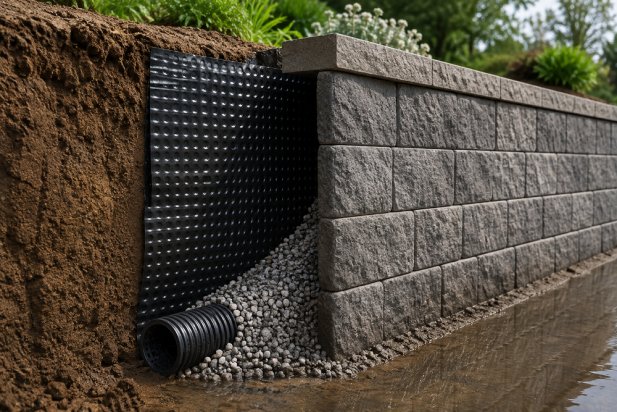
A proper subsurface drainage system- think a slotted agricultural pipe in geotextile fabric buried under clean gravel- relieves that building hydrostatic pressure. Once you’ve taken the pressure off, your waterproof coating can actually do its job without being blasted off by trapped moisture.
Positive-Side vs. Negative-Side: Choose Your Battle
How you seal the wall depends entirely on where you apply the barrier:
- Positive-Side (The Outside): This is your gold standard. Applied to the soil-facing side during construction, it stops water from ever touching the concrete. The catch? You must do this before backfilling.
- Negative-Side (The Inside): If you’ve inherited a failing wall and digging up the garden behind it will cost a pretty penny, negative-side waterproofing is your saving grace. Applied to the dry, exposed face, it manages dampness. It keeps the face looking neat, but the concrete behind it still remains wet.
The Waterproofing Toolkit
You aren’t short on choices for materials. Heavy-duty bitumen sheets are incredibly tough and offer uniform thickness, making them a favourite for big builds. Then you have liquid membranes, painted or sprayed on. They cure into a seamless, highly elastic skin that handles awkward corners and settling cracks like a breeze.
If you want a wall that stands the test of time, you can't cut corners. First, clean the blockwork and patch any holes. Next, roll on primer to make sure your membrane sticks. Don't forget a flexible bond-breaker sealant at the wall-to-footing joints. After applying two robust coats of liquid membrane, protect it with a dimpled plastic sheet before throwing in your drainage gravel. For masonry walls, leave weep holes near the base. They act as essential pressure release valves.
DIY vs. Professionals
If you’re just putting together a low garden bed under a metre high, a DIY run with quality sealant and a basic gravel trench is a great weekend project. But if your wall is holding back a massive slope, don't risk it.
That’s when calling in professional retaining wall waterproofing services is a no-brainer. They will do the heavy lifting, saving your back and your weekend. Licensed Australian specialists understand precisely how to deal with complicated Drainage calculations and soil conditions. Also, apart from knowing all that, professionals use special heavy machinery and commercial-quality products that can warrant their work.
Conclusion:
So, even if one day, after many years, you suddenly find out that there was a leak somewhere around the property or that soil movements have damaged the fence, you would not be left alone in the situation.


























This article provides essential information for homeowners dealing with moisture issues. Proper waterproofing of retaining walls is crucial to prevent costly structural damage and basement flooding. The practical tips shared here are invaluable for maintaining long-term property protection. 정보이용료 현금화