
Walk into any Australian manufacturing plant, food processing facility, or mine site, and you will hear filtration vessels quietly humming away in the background. Yet, a surprisingly common mistake engineers make is ordering replacement cartridges based purely on physical dimensions. Your system will probably be quickly clogged and experience huge pressure drops if you size it based only on existing pipe sizes. A selection of a good cartridge filter is not just about matching its length and diameter; it needs that you go into the details of fluid dynamics, types of particles, and chemical compatibility to ensure your Australian operations run smoothly and that there is no costly downtime.
Totally ignoring these aspects is just a way to end up in trouble and cause disasters to occur. If you just say to yourself, "she'll be right, " you'll eventually face a huge disappointment.
Step 1: Map Your Critical Process Conditions
Before looking at a manufacturer's catalogue, you need to map out your process conditions. Think of it as a pre-flight checklist:
- Hydraulic parameters: What is your normal operating flow rate versus peak flow? What are temperature limits and design pressures?
- Differential pressure limits: Understand clean differential pressure versus terminal targets. Most systems aim for an initial clean drop under 2 psi (14 kPa), scheduling change-outs before elements hit structural limits, usually 30 to 50 psi.
- Contaminant profiling: Is the solid load sticky, crystalline, or sandy?
- Fluid viscosity: Viscous fluids, like oils or syrups, require more surface area to avoid choking the system. You cannot guess this without an audit.
Step 2: Decode Nominal vs. Absolute Ratings
When shopping around, you will encounter nominal and absolute ratings:
- Nominal filters: These are the workhorses for non-critical tasks, capturing 50% to 90% of the particles, very useful for pre-filtration.
- Absolute filters: These kinds of filters are said to have a 99. 98% capture rate, so they are a must-have for sterile drug or beverage processing lines. A Beta Ratio refers to the measurement of filters of this quality. A Beta ratio of 5,000 would mean one particle out of 5,000 gets past the filter.
Have you ever seen a cleanroom or air purifier and wondered what HEPA filters are and how they work? It might look simple, but in fact those filters work by a physical process involving the three mechanisms of diffusion, interception, and impaction to catch airborne particles as small as a tenth of a micron, which is the same size as the flu virus. Like that, liquid absolute-rated cartridges have the physical barriers that guarantee high-purity containment of the fluids. Either way, under different conditions, the effectiveness of these two technologies is the same when it comes to filtering.
Step 3: Choose Your Filter Media Style
Now, choose your weapon:
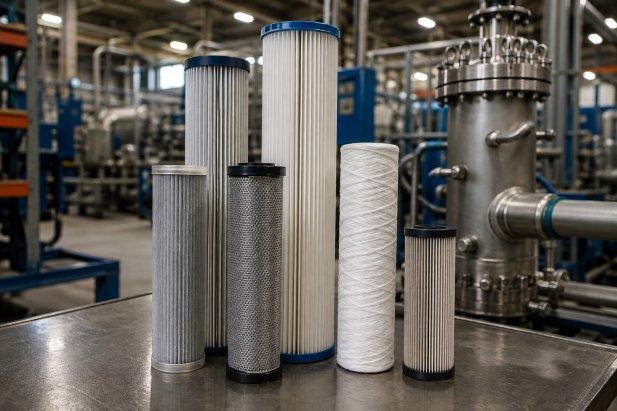
- Depth cartridges: Made of wound cotton or melt-blown polypropylene, they trap dirt throughout their entire thick cross-section. They are absolute champions for high-turbidity liquids because gradient density handles heavy sediment without immediate blinding.
- Pleated cartridges: Such filters use folding elements to create a large surface area even in a small space, allowing for high flow rates and very low-pressure losses when operating with clean air. They are very good for picking up fine particles. Besides, washing them and using them again is usually quite easy.
- Membrane filters: This feature ultra-precise, verified pore structures specifically tailored for final sterile polishing.
Step 4: Consider the High-Flow Upgrade
When your facility is responsible for processing large volumes of liquid like reverse osmosis pre-treatment, beverage processing, or a municipal water supply, the regular 2. 5inch cartridge filter elements will soon become a burden for your crew. That is unnecessary and really demanding work.
Enter high-flow cartridges:
- Compact physical footprint: Typically, 6 inches in diameter with an outside-in flow path.
- High-volume performance: A single high-flow element handles up to 300 gallons (over 1,100 litres) of water per minute.
- Operational savings: Effectively replaces several traditional small filters, meaning less waste and faster maintenance turnarounds.
Step 5: Factor in Chemical Compatibility and Life-Cycle Costs
Material compatibility is one of the issues that are quite often missed, which is really important under the kind of Australian conditions where the temperatures can change drastically in a day.
- Metals: Always make sure that they are not just generic stainless steel, as metals, harsh chemicals, brines or hot acids might require something more advanced like 316L, titanium or fluoropolymers.
- Elastomers: Exactly like the metals case, you will want to pick a sealing material like Viton, EPDM or Buna-N because this is what separates a reliable seal from a deadly leak that will bypass everything.
This leads to the ultimate metric: Total Cost of Ownership. Upfront cartridge cost accounts for just 10% of your filtration budget, while energy consumption, the power required to pump fluid past a clogged filter, can account for up to 80%. Buying a cheap, restrictive filter that clogs quickly forces premature cartridge filter replacement cycles, driving up energy bills and labour costs. Sizing your system slightly larger upfront reduces operational resistance, saving thousands annually.
Conclusion:
Finally, choosing a filter that is suitable is largely a matter of weighing up particle sizes, the fluids' chemistries, and the costs related to operations. Focusing on your hydraulic signature and overall cost of ownership, you will be able to maintain your plant at maximum performance day after day. Partnering with a reputable, local Australian filtration specialist is always the safest possible bet to ensure your plant runs smoothly without any surprise shutdowns.